
Searching Clearwater County Civil Dockets
The fastest remote route to a public Clearwater County civil case exists online. It is Minnesota Court Records Online (MCRO) Case Search. Pick Clearwater under the specific county court locations. If you already know the category, select Civil. Opening Case Details brings up the Register of Actions for the matter. Keep in mind the display identifies the case and its activity. It is not a certified record, and it may not show every public document sitting at the courthouse.
Enter the full case number from a court notice whenever you have one. Party searching matches exact names. So run separate searches for a middle name, an initial, punctuation variants, or a suffix. Date-filed and case-status filters can narrow a long list. Use them cautiously, though, because a wrong filter can hide the very case you want. Search a business caption as a business, not as a person.
- Open MCRO Case Search, accept the terms, and choose Clearwater from the county court locations.
- Select Case Number for a known civil case, or choose Name and the correct person or business mode.
- Use the Civil category and known filing-date or status filters only when they will not exclude the record.
- Review the result card for the case number, caption, filing date, status, and Clearwater venue before opening it.
- Read Case Details, including events, hearings, dispositions, and public document links. Contact Court Administration for official copies or missing public material.
Clearwater County Civil Case Searches
Civil case numbers in Clearwater County carry the CV type code. The official calendar shows them in the format 15-CV-26-146. The 15 is Clearwater County's number, CV marks a civil case, 26 is the filing year, and the last segment counts that year's sequence. MCRO number search accepts dashes and leading zeros. It rejects spaces. Attorney search also works when you know the attorney's name or full bar number.
| Search field | Clearwater civil use |
|---|---|
| Name | Choose person or business and use the exact-name tips, with wildcard or Sounds Like used separately. |
| Case Number | Use the complete 15-CV-year-sequence number without spaces. |
| Attorney | Search attorney name or a complete bar number where that information is available. |
| Date Filed | Use the exact date or a date range only when known. |
| Court Location | Select Clearwater rather than statewide for a known local venue. |
Result cards come from the MCRO case-search service. For docketed money judgments, use MCRO Judgment Search instead. It sorts by debtor name, docketed date, status, and location. It won't replace Case Search, though, when you need the full civil Register of Actions.
Inside a Clearwater County Civil Docket
A public Clearwater County civil Register of Actions can list the case header, parties and attorneys, the complaint or petition that started the case, service and answer events, motions, notices, orders, hearings, and a disposition. MCRO shows Case Events newest-first. Reading from the filing forward often makes the story clearer. The newest entry usually flags the immediate next action.
| Case information | Case number, caption, type, filing date, Clearwater venue, judicial officer, status, flags, and related cases. |
|---|---|
| Parties | Plaintiff or petitioner, defendant or respondent, other role, and attorney of record where publicly available. |
| Initiating and service events | Complaint or petition, summons or citation, filing, service, and answer entries. |
| Motions and orders | Requests, notices, hearing settings, and signed orders where public; a filed motion is not a granted motion. |
| Disposition and judgment | Judgment, dismissal, settlement, default, or other result, plus satisfaction or appeal information when recorded. |
Don't read Closed as an outcome by itself. A closed case may have ended by settlement, dismissal, default, nonsuit, or judgment. The same caution applies to calendars. A Motion Summary Judgment label marks a hearing on a motion, not a final judgment.
Clearwater County Civil Event Terms
Clearwater County posts no local key for short docket codes like DWOP. Read the full event text instead. Pull any signed order that goes with it. The plain-language terms here describe how civil records are read; they are not claims that every word is a Clearwater code.
- Judgment
- A court-entered decision or money award.
- Default judgment
- A judgment entered after a party fails to respond or appear as required.
- Nonsuit
- A plaintiff's withdrawal or dismissal of a claim, subject to procedure and any court order.
- DWOP
- Dismissal for want of prosecution when a court uses that phrase.
- Satisfaction
- An entry showing that a judgment was paid in full or in part.
After any motion, check the related hearing and the next event. The Register of Actions may show a filing first. A later order or disposition may follow it. That gap matters. It separates a request from the court's actual ruling when you track a Clearwater County civil docket.
Civil Case Types on the Docket
Clearwater County District Court holds original jurisdiction over civil, family, probate, juvenile, criminal, and traffic matters. The civil-related categories in MCRO materials include tort and personal injury, contract, consumer credit, condemnation, forfeiture, property or Torrens, conciliation, implied consent, minor civil judgments, and unlawful detainer. Family records use FA rather than CV. Their remote-access rules are separate.
- Major civil matters such as contract, tort, property, and condemnation cases.
- Conciliation, Minnesota's small-claims process, and other minor civil records.
- Unlawful-detainer cases within the District Court civil or minor-civil categories.
- Money judgments and related satisfaction, transcript, or appeal activity.
- Family, probate, and mental-health matters that use distinct categories and access rules.
One unified court does not mean equal access to every document. Check the case type and prefix first. That single step points you to the right Register of Actions, calendar line, or courthouse-terminal record.
Clearwater County Conciliation Records
Conciliation is Minnesota's small-claims process. Its Clearwater County records run through the District Court. The current Clearwater fee page lists a $75 first-paper filing fee. It also lists a $320 removal or appeal to District Court fee, with $420 shown when the appealing party requests a jury at the same time. No dollar-limit figure is published here. Check the statewide conciliation materials before relying on any threshold.
Find conciliation and minor civil cases through the Civil category, the court calendar, or Court Administration when no remote public record exists. The Ninth District's 2022 annual report also notes a weekly eviction calendar. It was created after the statewide moratorium ended. That is calendar history, not proof that every current unlawful-detainer case gets its own docket.
Civil Docket Settings and Hearings
A Clearwater County civil docket can list several kinds of settings. Motion hearings, a Motion Summary Judgment setting, generic hearings, and reviews tied to family or probate matters all appear on the public calendar. Each line carries the case number, the hearing date and time, the location, the judicial officer, the hearing type, and connection details. Check the entry against the Register of Actions and the hearing notice too. A setting only tells you the matter is on the calendar. It does not tell you what the court will decide.
Dates can also drift out of date. Case Events sometimes leaves an older date in view after a continuance, a new hearing, or a later order takes effect, so the hearing notice and the most recent order control. The Clearwater public calendar PDF is a useful local cross-check. For calendar channels and what each field means, see the Clearwater County Court Dates reference. When the PDF and MCRO disagree, Court Administration can confirm the setting.
Clearwater County Civil Record Limits
Remote access is not the same thing as access at the courthouse. In family cases, public orders, judgments, court notices, and appellate opinions may be viewable remotely. Party-submitted motions, affidavits, and sensitive financial documents stay off the remote screen. Older filings and protected material may take a courthouse terminal. A call to local Court Administration may work too. That split matters. A case event can be public while its documents are not remotely viewable.
Minnesota General Rules of Practice Rule 11 puts the burden on filers to keep restricted identifiers out of ordinary public filings. It also permits temporary restriction while a document is redacted or corrected. The official Rule 11 page shows that public-record safeguard in full.
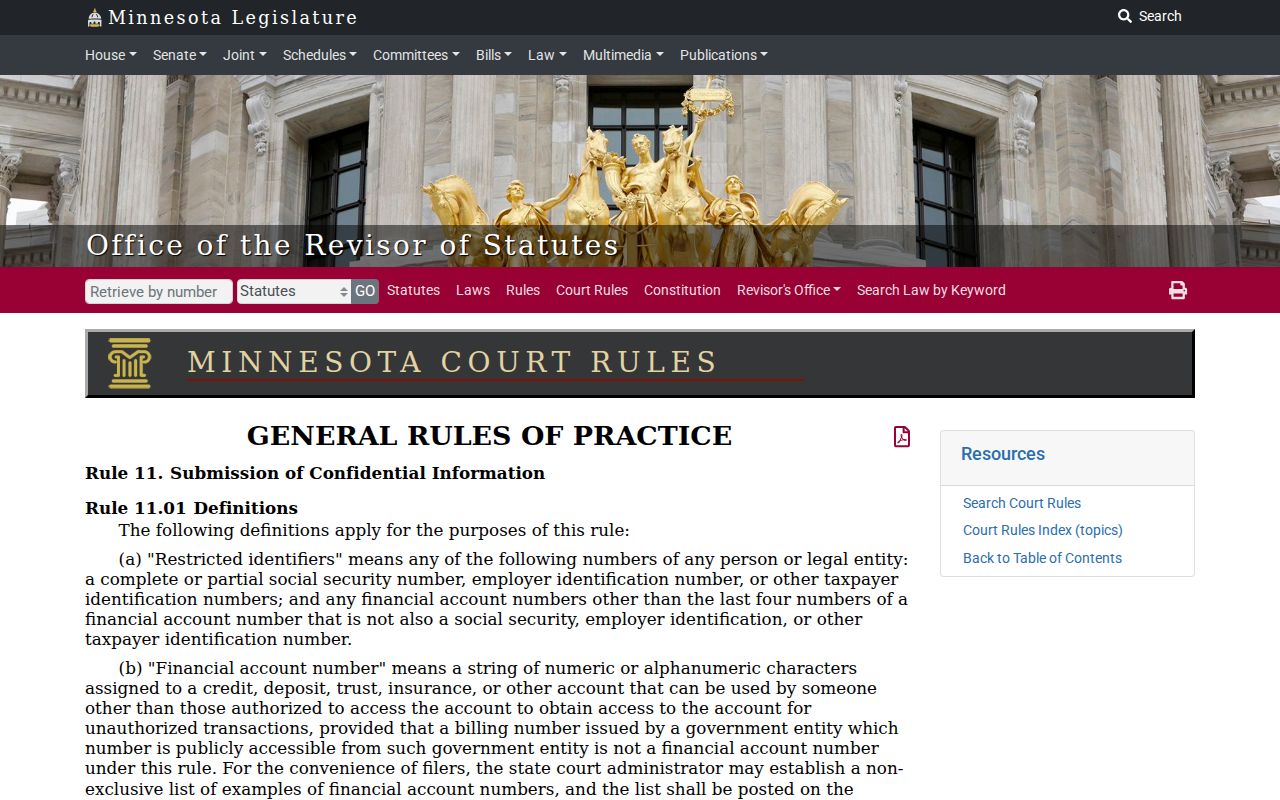
Protected identifiers can thin out remote details. This can happen even when a Clearwater County civil docket stays visible. For qualifying public material, the courthouse public-access terminal is the stronger electronic fallback. Court Administration can point you to the right record request channel.
Minnesota Statutes Chapter 609A is the state's expungement chapter. Court-access questions sometimes involve a record that a separate restriction or order keeps from the public. That official statute page sets out the full framework.
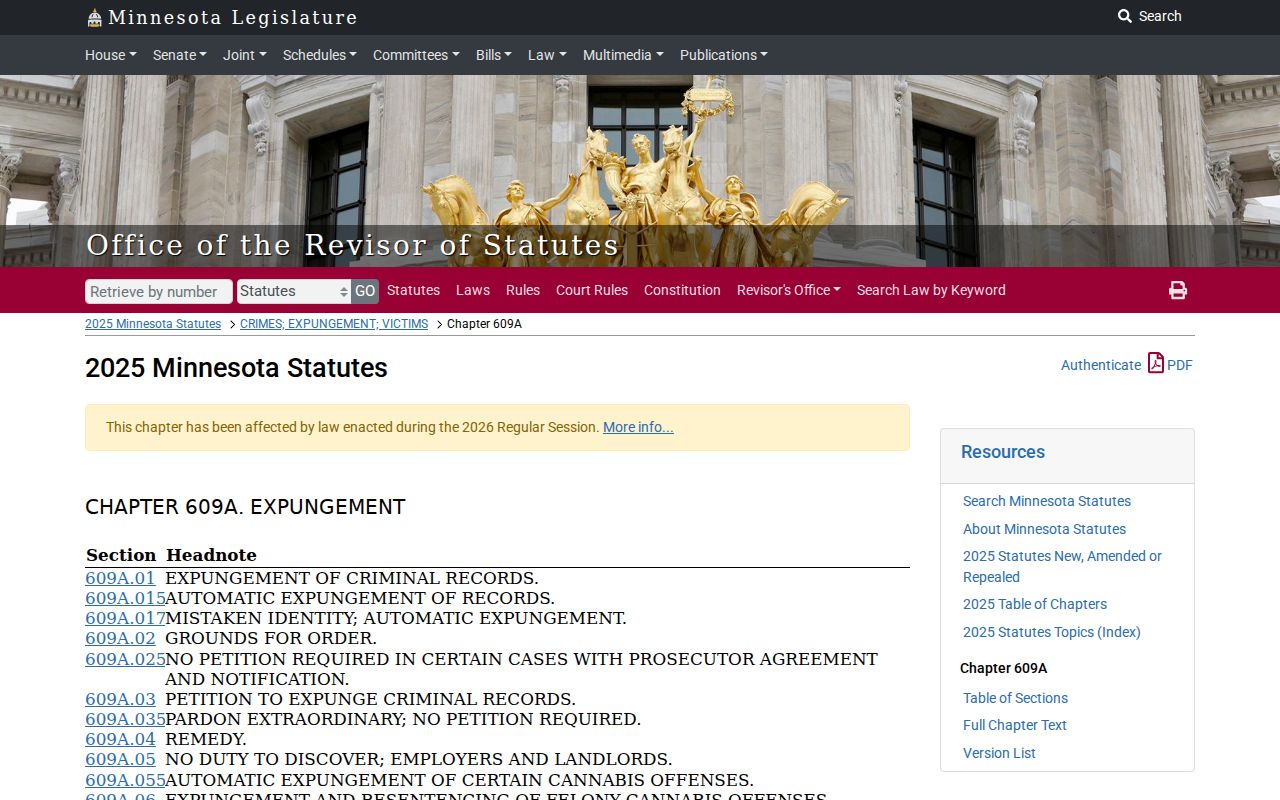
A missing record does not say why it is missing. The file could be nonpublic, non-remote, sealed, mid-redaction, or gone under a retention rule. Local court staff can explain the access route. They cannot change an access classification.
Civil Docket Access Rules
Minnesota Rules of Public Access Rule 8 governs judicial records. It covers inspection, copying, and remote access. Start remotely with MCRO for available registers, calendars, and documents. The Clearwater courthouse terminal fills the gap. So does the local counter. They step in when a qualifying public record is not online. Certified copies come from Court Administration, not from an MCRO display.
The official Rule 8 page highlights the headings that define public access and remote access. It backs up a practical point. A public court record may carry one level of electronic access. In person, the access level can differ.
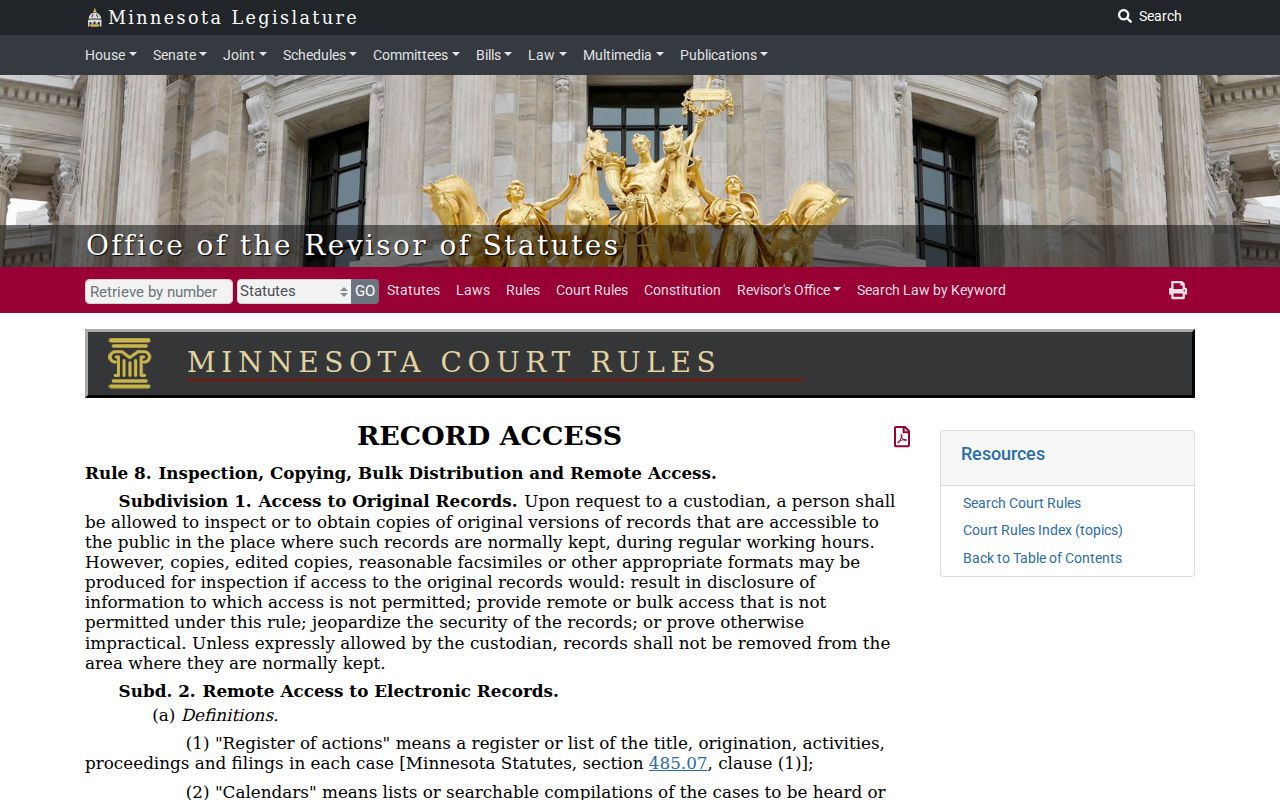
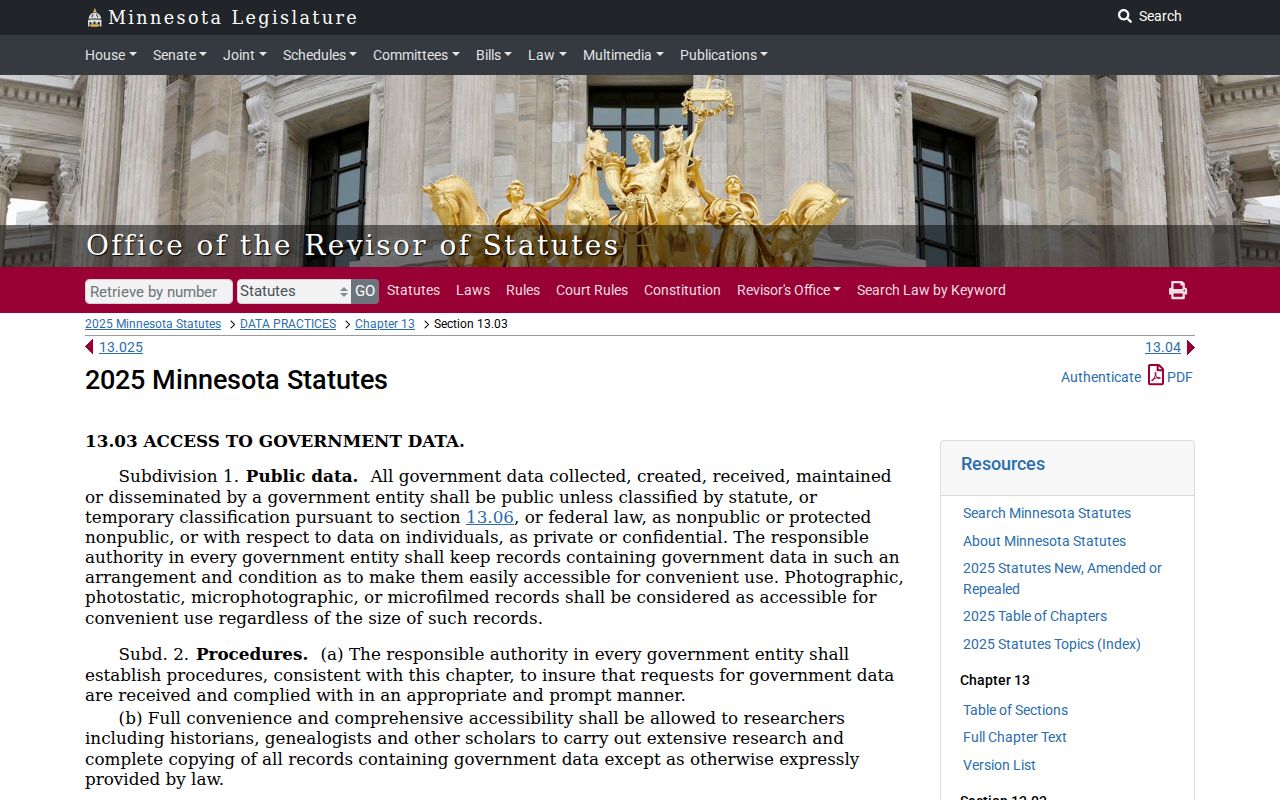
For a Clearwater County civil docket, this distinction can leave a remote result incomplete even when the record itself can be read at the courthouse. Minnesota Statutes section 13.03 sets the inspection and copying baseline for public government data. The official statute page lines up with the difference between inspecting available public material and ordering copies through the proper office.
Clearwater County civil records carry no charge of $0 for uncertified copies or printouts. A certified instrument costs $14, and an exemplified and certified copy runs $28. Confirm the current fee and delivery method with Court Administration before you request a particular format.
Access point: MCRO supplies an unofficial remote Register of Actions. The Clearwater courthouse terminal and Court Administration are the next channels for qualifying public records, official copies, older documents, and access questions.
Clearwater County Civil Judgments
A Civil Case Search and a Judgment Search answer different questions. Case Search opens the filing history, hearing events, orders, and disposition. Judgment Search instead tracks docketed money judgments by debtor name, date, status, and court location. Judgment Details may show parties, judgment information, and satisfactions. The fuller story sits in the Register of Actions.
| Need | Best Clearwater route |
|---|---|
| Filing history or hearing | MCRO Case Search, then View Case Details and the Clearwater calendar. |
| Docketed money judgment | MCRO Judgment Search by debtor, date, status, and Clearwater location. |
| Official proof or transcript | Clearwater County Court Administration, with the requested format identified. |
Clearwater County Court Administration sits at 213 Main Avenue #303, Bagley, MN 56621. It lists (218) 935-4020 for local contact. Ask about handling at the counter. Ask whether mail works instead. Be exact about the record type. A certified instrument, an exemplified copy, a report, a satisfaction, and a transcript are not interchangeable.